

A Map for Smells Inside the Nose?
New mouse studies suggest that smell may begin with spatial order, not only molecular detection.

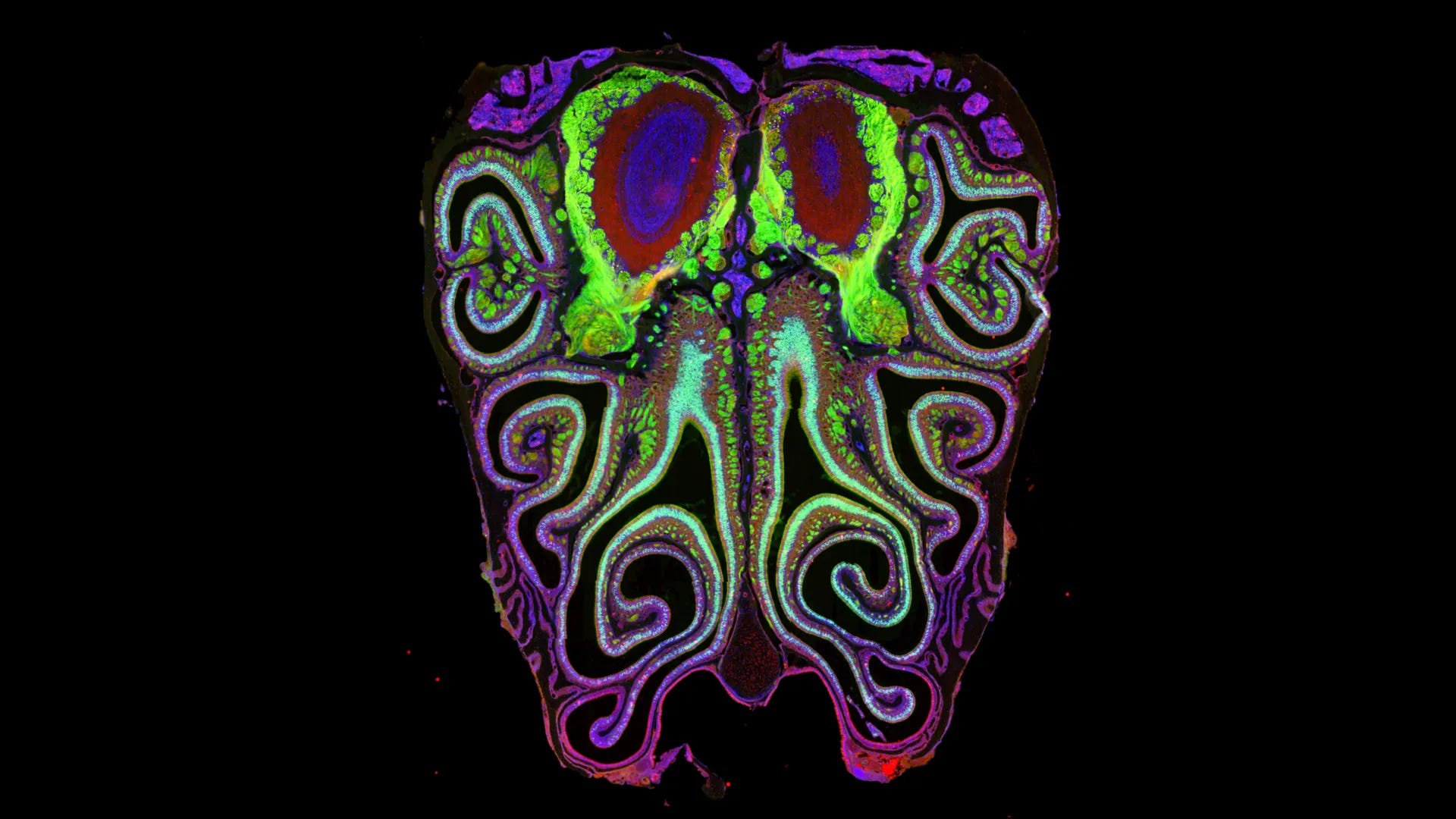
When smell is altered after an infection, coffee can become only heat and bitterness. Wine loses its aroma. A familiar perfume may still be detectable, but strangely hollow.
In another setting, after spending months training, a perfumery student learn to distinguish bergamot from lemon, rose from geranium and lavender from lavandin. With expertise, odors begin to separate.
Both situations begin in the olfactory epithelium, high in the nasal cavity, where odor molecules first come into contact with olfactory neurons.
The textbook version of smell is familiar. Odor molecules bind to receptors. Each odor activates a combination of receptors. The brain interprets the pattern as coffee, smoke, rose, cheese, wine, danger, comfort or memory.
That is not wrong. But two new papers in Cell, make the first step look less random than we thought.
What did they find?
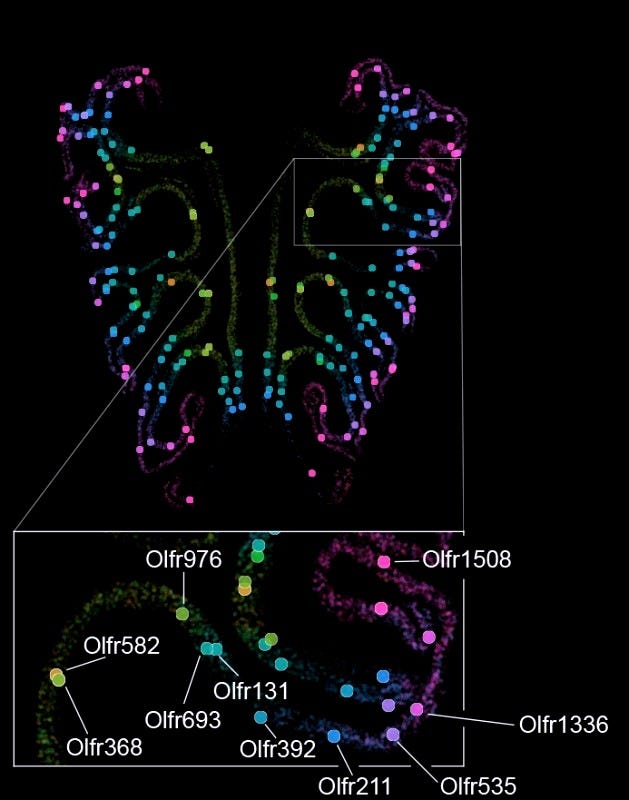
In mice, olfactory receptor neurons are not just scattered across the nose. Neurons expressing particular receptor genes tend to occupy particular positions in the main olfactory epithelium. This organization is aligned with maps in the olfactory bulb, the first brain relay for smell.
In one study, Brann and colleagues report that around 1,100 olfactory receptors adopt stereotyped spatial distributions in the epithelium, with receptor positions aligned with axonal targets in the bulb.
In the companion paper, Bintu and colleagues map near-complete olfactory receptor expression in the mouse main olfactory epithelium and olfactory bulb, showing gradients mirrored in bulb projections.
The nose would not just be a passive surface waiting for the brain to make sense of molecules. It may already organize olfactory information at the first stage of detection.
What this means for human smell
The human question is still open.
Mice have a larger functional olfactory receptor repertoire than humans. We cannot paste the mouse map onto the human nose.
But humans also show large individual differences in odor perception. Some of these differences come from variation in olfactory receptor genes. A molecule can seem intense, pleasant or faint depending on the receptors you carry.
That matters for perfumery, food, wine, and clinical smell testing. A disagreement between two people is not always “subjective noise.” It may reflect receptor genetics, epithelial biology, experience, vocabulary, context, and the task itself.
The next question is not whether humans have the exact same map as mice. They almost certainly do not.
The better question is whether human olfactory receptors are also spatially organized in ways that matter for vulnerability, recovery and perception.
Why this matters for smell loss
Smell loss is often described too globally. Someone “lost smell,” “recovered smell,” or “has reduced smell.”
But in real life, it is rarely that simple.
Some people detect odors but cannot identify them. Some lose certain odor qualities more than others. Some recover with distortions, as in parosmia, where familiar odors like coffee, meat, onions or perfume become unpleasant or unrecognizable.
A spatial map in the nose would not explain all of this. Smell loss can involve airflow, mucus, inflammation, the olfactory epithelium, receptor neurons, the olfactory bulb, or cortical processing.
But a better map of the first sensory layer could help us frame better questions.
If the olfactory epithelium is spatially organized, then recovery may not only mean that new neurons grow back. It may also matter which receptor populations return, where they return and whether their projections reconnect correctly.
For now, the most practical intervention for many post-viral smell disorders remains olfactory training: repeated, structured smelling over weeks or months. Reviews suggest it can help some people but responses vary and spontaneous recovery makes the evidence difficult to interpret.
A future map of the human olfactory epithelium would not replace olfactory training. But it could help us understand what exactly is changing when smell returns.
I wrote more broadly about why smell loss matters in daily life, aging and health in my post on olfactory myths and anosmia.
A question for you
Have you ever lost, distorted or recovered your sense of smell? Did all smells change equally or were some odors more affected than others?
I’d be curious to read your experience in the comments.
If you want more science of smell, flavor, memory, perfumery, food and sensory expertise, you can subscribe to Flavors of Science to receive the next posts.